|


MICHAEL MENASTER, MD, MA, San Francisco Psychiatrist
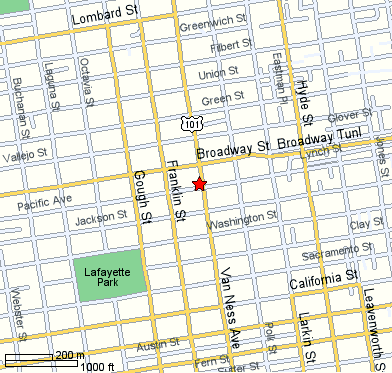
2107 Van Ness Avenue, Suite 102A San Francisco, CA 94109 (415) 204-2344 Please see the bottom of this page for a map.
|
 |
PRACTICE STYLE
Prospective patients sometimes ask about clinicians' practice style. Although the specific style depends in large part on the patient's circumstances, the following generalizations describe Dr. Menaster's approach. In an interactive, compassionate and non-judgmental manner, Dr. Menaster listens, strives to understand the patient's circumstances, stresses, needs, and preferences. He seeks to develop rapport and establish a trusting, professional relationship with patients. When possible, he seeks to provide diagnoses, not to label or stigmatize patients, but rather to help them understand their condition and to guide treatment. Diagnoses provide guidance as to causes and exacerbating circumstances of the patient's condition. With a diagnosis and understanding of the patient's condition, Dr. Menaster can then suggest a treatment plan. He spends the time to educate patient about their diagnoses, particularly known causes and factors that likely worsen symptoms. Medications aren't for everyone; when medications might be helpful, Dr. Menaster takes the time to perform a detailed informed consent, discuss options and alternatives, recommends that patients give serious deliberation to deciding whether or not to take medications, and encourages for active patient participation in this process. He can work independently or in cooperation with other psychotherapists and physicians. With patients' permission, Dr. Menaster maintains regular contact with significant others and other members of the health care team. In the forensic setting, he provides impartial (ie not plaintiff or defense-oriented) evaluations; Dr. Menaster is not affiliated with any medical group, hospital, university, or insurance company and will disclose any known conflicts of interest up-front. SCOPE OF PRACTICE Dr. Menaster has a diverse clinical background. Practice settings in which he has worked include university hospitals, Veterans Affairs hospitals, private hospitals, group and solo practice, family practice, and occupational/industrial medicine. Currently, his scope of practice includes: Adults, young adults, and adolescents on an outpatient basis. Anxiety Disorders Post-traumatic stress disorder (PTSD) Social phobia Performance anxiety (especially for actors and entertainers) Depression Head trauma/traumatic brain injury (TBI) ADD/ADHD Men's issues Eating disorders, including anorexia nervosa, bulimia nervosa, obesity, and binge eating Anger management Bipolar disorder/manic-depressive disorder Borderline personality disorder substance abuse Asian-American issues Self-esteem issues Coping with grief and loss Dealing with chronic illnesses, including HIV/AIDS Sexual disorders, including fetishes and sexual addiction LGBTQ issues Second opinions regarding psychotherapy and medications Impartial evaluations and reports for third parties (competency, disability, conservatorships, personal injury, PTSD, attorneys, courts, employers, schools, immigration, etc.) Psychological Testing. EDUCATION AND CREDENTIALS MD, The Chicago Medical School, North Chicago, Illinois Psychiatry Residency, LA County-USC Medical Center, Los Angeles MA, Forensic Psychology, Canyon College, Caldwell, Idaho BS, Chemistry, Loyola Marymount University, Los Angeles Certification in Eating Disorders, John F. Kennedy University Psychiatric Consultant, Equinox Group Psychiatric Consultant, The Brand Institute Psychiatric Consultant, Physicians Insight Panel Professional Reviewer, Williams and Wilkins Publishers Psychiatric Consultant, The Physicians Advisory Panel Psychiatric Consultant, The Council of Health Care Providers Instructor in Psychopharmacology, John F. Kennedy University, 2001 Clinician, Social Anxiety Disorder Referral Network, University of Wisconsin Clinician, Post Traumatic Stress Disorder Referral Network, University of Wisconsin PSYCHOLOGICAL TESTING CREDENTIALS MA in forensic psychology, Canyon College Certificate, Professional Program in Neuropsychological Assessment, UC Berkeley Extension Fully Credentialed with: Caldwell Report (MMPI-2) NCS Pearson Assessment NFER-Nelson (as a psychiatrist, 10641D) Psych Screen, Incorporated Psychological Assessment Resources, Incorporated University of Minnesota (MMPI-2) Western Psychological Publishing PUBLICATIONS Psychiatric Illness Associated with Criminality, eMedicine.com, September 2006, revised June 2008 Review of Precautions with Antidepressant Therapy, e-Medicine.com, Series 2, Issue 2, July 2007 Dosage Adjustments in Special Populations (traumatic brain injury, HIV/AIDS, and Asian Americans), e-Medicine.com, Series 2, Issue 1, June 2007 Venlafaxine and Cardiac Illnesses, e-Medicine.com, November 2006 Use of Neuroleptics in Primary Care for the Management of Bipolar Disorder, eMedicine.com, May 2006 Sexual Dysfunctions, Weight Gain, and Bupropion, Journal of Clinical Psychiatry, October 2005 Use of Olanzapine in Anorexia Nervosa, Journal of Clinical Psychiatry, May 2005 Anorgasmia in Women, e-Medicine Continuing Medical Education, September 2004 Anorgasmia in Men, e-Medicine Continuing Medical Education, September 2004 Antidepressants and Suicide: What the Data Show, Clinical Psychiatry News, May 2004 Psychometrics: a Valuable Tool, Clinical Psychiatry News, April 2004 The Role of Unmet Expectations, Clinical Psychiatry News, March 2004 Asian-American Mental Health Issues, Asia Pacific Perspectives, May 2003 Treating Physicians, Psychiatric Times, April 2003 Fee Policies: the 'Write' Way To Prevent Payment Disputes, Current Psychiatry, March 2003 Preparing Patients for Life after Bariatric (Obesity) Surgery, Current Psychiatry, January 2003 Risk Management with Electronic Media, 15th Annual US Psychiatric Congress, Las Vegas, Nevada, October 28-29, 2002 Controversies in Eating Disorders among Men, Psychiatric Times, October 2002 Improving Patient Compliance, Psychiatric Times, September 2002 When 'Informed' Patients Think They Know What's Best for Them, Current Psychiatry, August 2002 What You Don't Know Can Hurt You, SF Weekly, May 8-15, 2002 Reducing Biases, Metro Newspapers, May 2-9, 2002 Our Debt to the Mouse Community, SF Weekly, April 17-23, 2002 Eating Disorders in Men, Out Now Magazine, July 2001 Coping with HIV-related Depression, The Slant, July 2001 Memories of a Memory, Nob Hill Gazette, May 2001 Computer Phobia, Nob Hill Gazette, May 2001 A Return to Normalcy, Out Now Magazine, April 2001 The Stockholm Syndrome Revisited, San Francisco Bay View, August 16, 2000 Panic Disorder, Simi Valley Family Magazine, Spring 1995 PRESENTATIONS Why Patients Are Non-Compliant and How To Deal with It, National Alliance for the Mentally Ill, Concord, California, June 16, 2005 Depression and Its Effect on Medical Professionals, Fremont-Rideout Medical Center, Yuba City, California, November 4, 2003 Psychopharmacology for Therapists, John F. Kennedy University, 2001 Depression: Myths and Facts, St. Thomas More Church, San Francisco, 2001 Emergency Assessment of Psychiatric Patients, Tom Waddel Clinic, San Francisco, 2001 New Antipsychotic Medications, San Francisco Chapter of the National Alliance for the Mentally Ill (NAMI), 2001 Treatment Resistant Depression, St. Francis Memorial Hospital Grand Rounds, San Francisco, 2001 Recognizing and Treating Depression among Asian Americans, Northeast Medical Clinic, San Francisco, 2001 Psychopharmacology: a Survey Course for Therapists, John F. Kennedy University, 2001 The Treatment of Depression, Thousand Oaks, CA, 1999 New Treatments in Panic Disorder and Agoraphobia, Simi Valley, CA, 1996 The Diagnosis and Treatment of Obsessive Compulsive Disorder, Simi Valley, 1996 The Role of Medications in Treating Depression, Simi Valley, 1995 Selective Serotonin-Reuptake Inhibitors and Depression, Northridge, CA, 1995 Selective Serotonin-Reuptake Inhibitor Use in Depression, Simi Valley, 1994 Computer Applications in Psychiatry, LA County-USC Medical Center, 1994 Amino Terminal Radioimmunoassay for Human Parathyroid Hormone, North Chicago, 1990 Oriented Polycrystalline Film Growth from Solution for Infrared Studies, USC, 1986 Oriented Polycrystalline Film Growth from Solution for Infrared Studies, CSU Pomona, 1986 Amino Terminal Radioimmunoassay for Human Parathyroid Hormone, Los Angeles, 1984
Dr. Menaster's office is located 4 doors north of Pacific Avenue, on the northwest corner (on the same side of the street at Happy Donuts), and next door to the nail salon. When you enter the building, take the elevator up to the first floor or walk up one flight of stairs. The office is across from the elevator, in suite 102A. Dr. Menaster's name is on the door. PUBLIC TRANSPORTATION 12 Folsom 19 Polk 47 Van Ness 49 Van Ness/Mission
|